Polish (PL)German (DE)English (EN)
Consulting and order service: +48 512 999 218 
0

Hybrid mattress under the microscope - what are manufacturers hiding?

5 grudnia 2025
hybrid mattress, multipocket mattresses, springs in mattresses
Over a dozen years ago, hybrid mattresses stormed the market, promising customers that the durability of springs and comfort of foam would be the perfect match. To this day, marketers go to great lengths to convince us that combining two technologies is the pinnacle of sleep engineering. In reality, however, the hybrid mattress has become a convenient loophole for selling products with complex construction, which often does not translate into better sleep quality but rather into a higher price and a flashy catalog description.

Tempted by the vision of perfect spinal support, consumers rarely consider the technical aspects of this solution. Meanwhile, simply combining springs with foam layers - and even absurd and nearly useless extras like coconut fiber - creates a design fraught with many risks. As a result, instead of synergy in the mattress, we often get a compromise where the weaknesses of one technology are amplified by the other, all dressed up in fancy words.

Springs and pockets - why does this system fail?

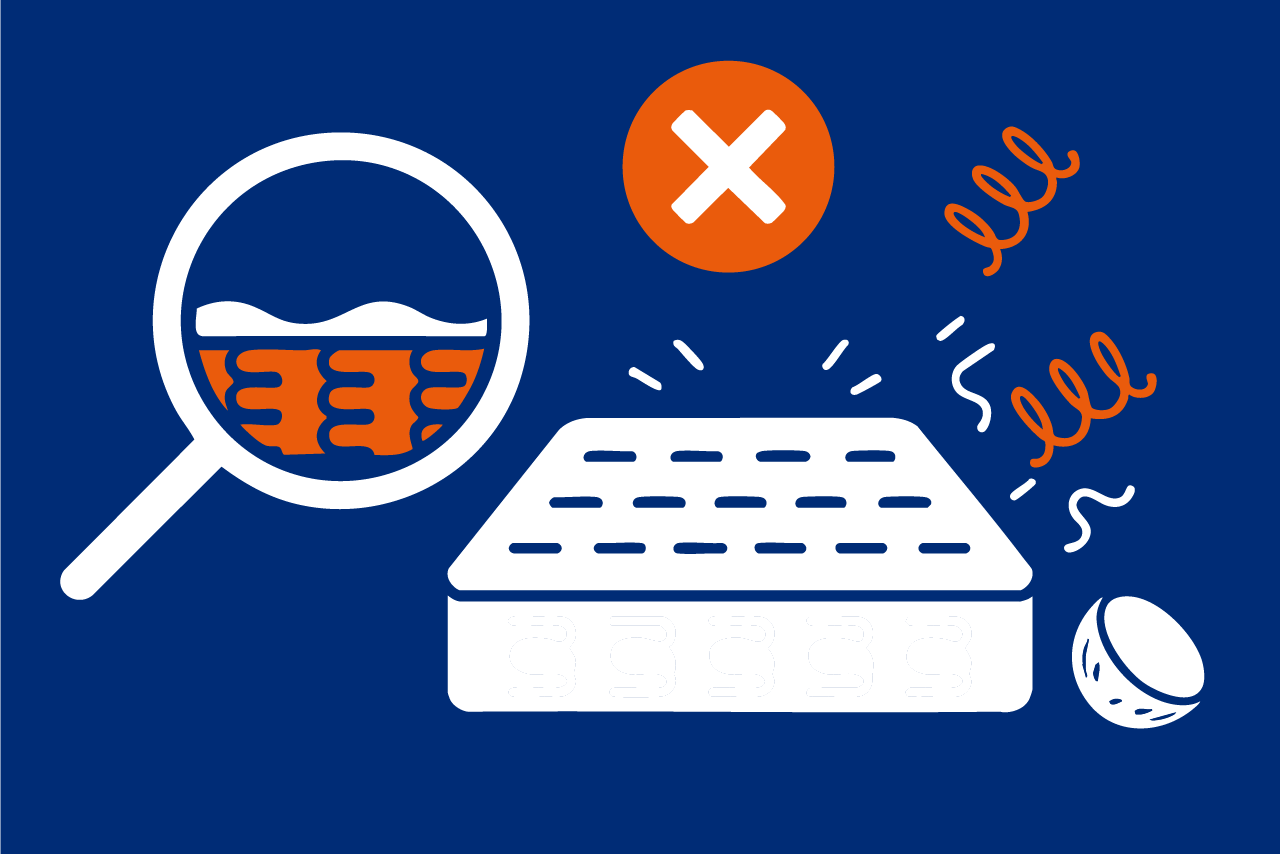
The foundation of most hybrid mattresses is pocket springs. In theory, each spring placed in a separate pocket should work independently, ensuring perfect point elasticity. In manufacturing reality, however, hybrid mattresses are made differently. To ensure the mattress structure remains stable, spring pockets are glued together, effectively creating one rigid unit. The glue stiffens the material, which means the supposed independence of the springs becomes an illusion. When you press on one spot, the adjacent springs - connected by a stiff bond - also respond to that pressure. This eliminates the promised precise spinal alignment effect.

Another issue is the low durability of metal under daily use. Very often, springs used in hybrid mattresses tend to fatigue quickly. Metal subjected to constant pressure loses its elasticity, leading to permanent sagging. After a relatively short time, the user starts sleeping in a dip, which is disastrous for sleep ergonomics and spinal health. The spine loses critical support in the lumbar region, which affects the entire back.

The lack of proper support in spring mattresses - including hybrid ones - stems from the physics of how a spring works. It responds with a force proportional to compression, so the harder you press (for example, with your hips), the stronger the spring pushes back. This is the opposite of the contouring and pressure relief that modern foams provide. Instead of relaxing your muscles, the body fights the resistance of the metal, often resulting in morning back pain and a feeling of not being rested - even after investing in an expensive hybrid model.

Coconut mat - eco-friendly myth or harmful waste?

Many manufacturers, wanting to firm up hybrid mattresses while giving them an eco-friendly label, use coconut fiber inserts. This is a marketing gimmick with little to do with logic or health. The coconut fiber used in mattresses is a cheap manufacturing by-product with no orthopedic properties. Its only purpose is to stiffen the mattress at almost no cost, which comes at the expense of point elasticity.

Even worse, making organic mattresses that contain materials like coconut or buckwheat poses a hygiene risk. Coconut absorbs moisture released by the body during sleep, and in the warm, dark interior of a mattress, it becomes an ideal breeding ground for mold, fungi and dust mites - which has nothing to do with cleanliness. Unlike synthetic open-cell foams, coconut mats hinder airflow and can begin to rot over time. Increasingly, cases of bugs in mattresses are being reported - especially those filled with buckwheat.

From a logical standpoint, placing a rigid coconut mat on top of working springs is a design flaw. This mat blocks the function of the mattress layers that are supposedly meant to adapt to the body. Instead of spinal support, you get a mattress as hard as a board, which compresses tissue, restricts blood flow, and forces frequent position changes during the night. Coconut in a mattress is a relic of the past that has no place in a modern bedroom.

Functionality over marketing - why does foam win?

The answer to many flaws of spring and hybrid mattresses are modern high-resilience foam mattresses, such as the Osaka Air mattress, manufactured in Toruń. Unlike hybrids, our Polish ONSEN® mattresses are designed based on human physiology. High-quality foam mattresses feature an open-cell structure that ensures excellent ventilation, preventing the growth of microorganisms.

The key advantage of a functional foam mattress is genuine point elasticity and the absence of spring fatigue. The Osaka Air mattress is engineered to respond to body heat and pressure in a way that avoids pushback or sinking. As a result, the spine is supported in a natural position, and muscles can fully regenerate. There is no risk of pocket rupture, delamination of layers, or squeaking metal.

When choosing a mattress, it's worth relying on logic, not catchy hybrid slogans. The complex structure of a hybrid mattress is often a smokescreen for flawed solutions, such as sagging springs or unhygienic coconut inserts. Choosing advanced foam technology as represented by the Osaka Air mattress is a conscious decision. It's a choice that guarantees hygiene, durability, and healthy, restorative sleep without compromise.

A revolution is in the air - Osaka Grid is coming

Soon, the world of sleep is about to be shaken in a way that will forever change how we think about mattresses. The Osaka Grid mattress is coming - our new product that completely redefines what a hybrid mattress means. Until now, hybrid mattresses represented a rotten compromise between foam and springs. Osaka Grid breaks that pattern, becoming the only hybrid of its kind on the market - without coconut or springs. It's a design that doesn't fix old mistakes - it creates a whole new category, with no place for metal or pockets.

The first layer of the Osaka Grid mattress contains no foam, coconut, or springs. Instead, it's made of a special polymer - the most technologically advanced material in the industry. This polymer is the heart of the mattress and the core of the entire revolution. Thanks to it, Osaka Grid is the first true springless hybrid that offers unmatched durability and adaptability. The polymer grid does not sag or lose its properties, working with the body in a way that no metal coil can replicate. It's the end of material fatigue - and the beginning of technological perfection.

What the Osaka Grid mattress offers is not just comfort. At its core is the feeling of sleeping on air, yet with true support. The unique structure of the polymer in the top layer ensures airflow and pressure relief, making gravity feel irrelevant. This model literally changes the mattress world, pushing traditional spring constructions into the past. Get ready for a new standard - the Osaka Grid mattress is not just another addition to the catalog. This mattress is simply the future we’ve all been waiting for - even if we didn’t know it was possible.

We also encourage you to explore other articles on the best sleep and health blog, as well as the Encyclopedia of Healthy Sleep prepared by the ONSEN® team of specialists. For those who care about spine health, we recommend a set of spine exercises prepared by our physiotherapist.

FAQ: Hybrid mattress

What is a hybrid mattress?

Traditionally, a hybrid mattress is a design that combines two different support technologies in one product. Most often, it's a combination of a base made of pocket or multipocket springs with a top layer of foam - typically standard or memory foam. However, global standards are evolving, and so is the definition. A true hybrid should take the best of available technologies - not just be a compromise. In 2026, ONSEN? will introduce a new generation of hybrid mattresses in Poland that eliminate springs altogether in favor of advanced polymers and foams.

What makes the Osaka Grid mattress different from other hybrid mattresses?

Instead of faulty springs, the Osaka Grid hybrid mattress features an advanced polymer grid. Its top layer is made of a specialized polymer that delivers the sensation of sleeping on air, offering excellent airflow and almost no pressure points. The polymer structure does not fatigue or sag, ensuring long-lasting durability. It?s the most advanced mattress on the market. Osaka Grid redefines the concept of a hybrid, likely becoming the first springless hybrid mattress.

Is a hybrid mattress a good choice?

It depends on the mattress construction. Traditional hybrids (spring + foam) are often a poor compromise. They might be a decent choice only if the manufacturer avoids cheap fillers (like coconut mats), doesn?t glue the spring pockets into a rigid block, and uses high-resilience foams. Still, the inherent issues with springs remain. In contrast, modern hybrids like Osaka Grid are an excellent choice for those seeking a perfect balance between support and comfort, as they eliminate the downsides of springs - squeaking, sagging, electromagnetic interference, and more.

Which hybrid mattress is the healthiest for the spine?

The healthiest mattress is one that provides real point elasticity and doesn?t exert pressure back onto your body. For spinal health, the best hybrid mattress is one that avoids stiff layers, springs, and inferior foams like T- or V-foam in the top layer. Models based on high-resilience (HR) foams and polymer grids - such as Osaka Grid - are considered healthier, as they allow the spine to rest in its natural alignment, do not disturb blood flow, and let muscles fully regenerate.

Why do spring-based hybrid mattresses lose to foam mattresses?

Spring-based mattresses, even pocketed ones, suffer from design flaws that high-quality foam mattresses do not. In many spring models, the pockets are glued together, creating a rigid surface that cancels out point elasticity. Springs react with force proportional to pressure - the more you press (e.g. with your hips), the more force they push back with, causing pressure on the body. Quality foam works oppositely by relieving pressure. Over time, metal loses resilience and forms permanent indentations. The inside of a spring mattress is a hollow space that collects dust, dead skin, and mites. In contrast, open-cell foam mattresses are breathable and do not promote mold growth.

Share
Newsletter - stay up to date!
Without your consent, we cannot add your e-mail address to the ONSEN® newsletter subscriber base.
Thank you for joining the ONSEN® newsletter subscriber group!
Comments
There were errors in the form.
First name or nickname *
E-mail address (will not be visible)
Telephone number (will not be visible)
Comment *
Thank you for adding a comment!
Learn more about how to choose the best mattress...

Producer of the boldly perfect Osaka Air mattress, anatomical pillows, and ergonomic furniture. A leader in the European market.