

To provide services at the highest level, we use cookies. Using the website requires you to choose settings related to their storage on your device. If you want to know what each type of cookie is used for, click the Details button below.


How to determine foam firmness and why it matters?20 marca 2026 |

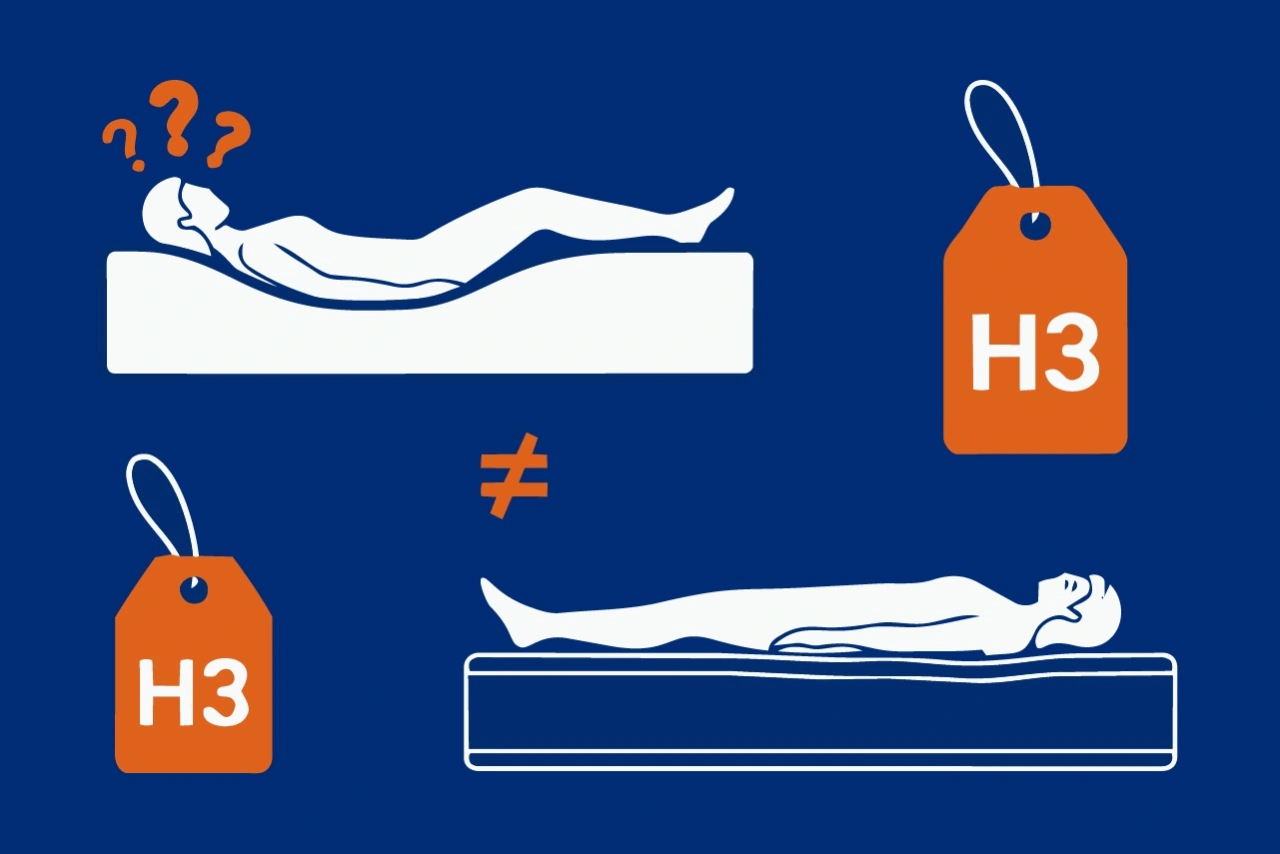
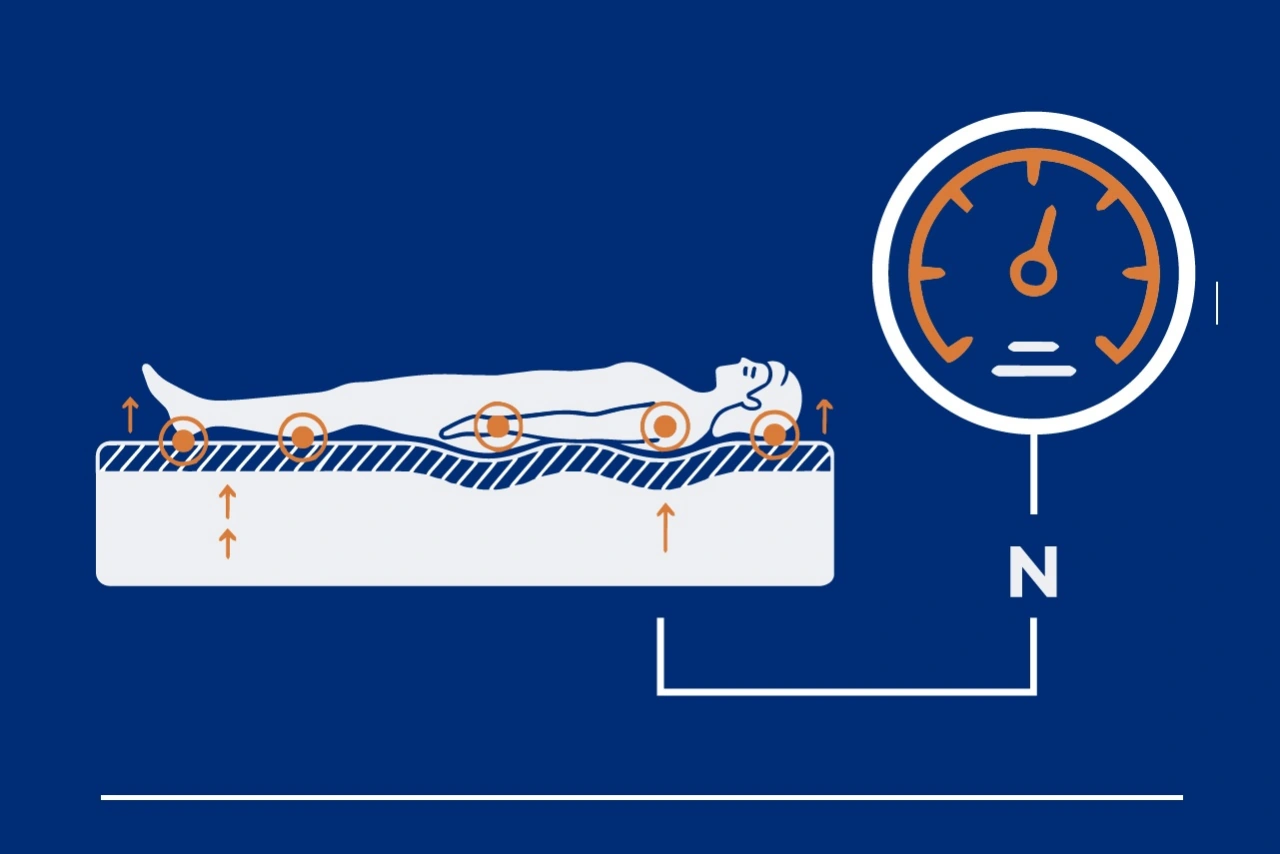

Poland is probably the only country dominated by a mattress firmness scale that has no official standard and is additionally based on the user?s body weight. It is commonly assumed that an H1 mattress is intended for users up to 60 kilograms, H2 for 50 to 80 kilograms, the popular H3 for 70 to 110 kilograms, and H4 for those above 100 kilograms. But what does that actually mean? In practice, nothing. The scale is not standardised, and defining foam firmness solely by body weight is neither scientifically sound nor methodologically correct. A good mattress should feature a well designed layered construction that ultimately results in one clearly defined firmness value expressed in newtons (N) and kilopascals (kPa). For side and back sleepers, as well as most stomach sleepers, the optimal firmness is around 120 to 125 newtons. Young, athletic stomach sleepers may prefer slightly higher firmness.
Density and firmness are two completely different physical parameters, even though they are often confused in everyday language and sales communication. Density refers to the mass of foam per cubic metre and directly affects durability and resistance to deformation. Firmness, on the other hand, defines the amount of force required to compress the material. It is therefore entirely possible to produce high density foam that remains soft and comfortable while offering significantly longer lifespan than lightweight, low density materials.
The T30 designation does not allow a clear assessment of firmness because the number 30 refers only to density, meaning 30 kg/m3. It is a typical polyurethane foam with a closed cell structure, often chosen for its lower price compared to high resilience HR foams, but characterised by lower breathability and elasticity. To determine whether a specific T30 foam is firm, we would need to know the indentation force parameter. Without it, we only know the material?s mass, not its firmness level. The cellular structure and performance parameters result from the production technology and can be verified in laboratory tests and technical data sheets.
In orthopaedics and physiotherapy, the simple division into soft versus firm is being replaced by the concept of appropriate foam. Extremes are never healthy for the spine. Foam that is too soft fails to provide support, while foam that is too firm generates uncomfortable counter pressure. True quality and comfort depend on a thoughtfully engineered mattress design, where firmness is just one element alongside point elasticity and recovery performance. The best choice is the one that ensures a physiological body position, regardless of how the material is labelled on a firmness scale.
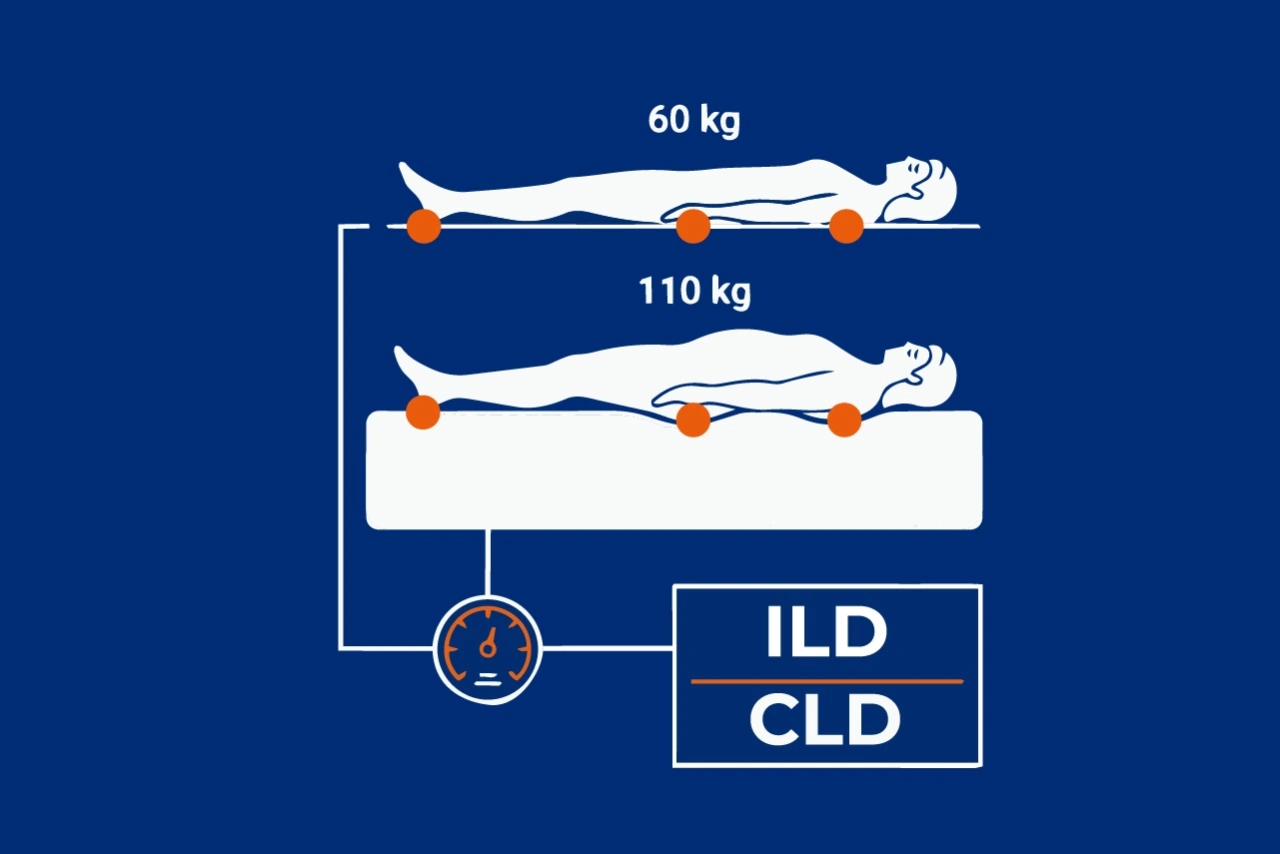
Choosing a mattress based on the H1-H4 scale and body weight is a marketing myth with no unified technical foundation. According to the physical formula for pressure p = F/S, in individuals with higher body mass the force is distributed across a proportionally larger contact area. This means that the unit pressure does not automatically increase dramatically. Instead of relying on arbitrary H labels, one should consider the ILD parameter measured in newtons, which objectively defines the force required to compress the foam. For 97 percent of the population, a firmness of around 120 to 125 newtons, approximately 6.5 on a 1 to 10 scale, is the optimal and health oriented solution. It ensures proper body contouring and spinal support without the harmful sensation of sleeping on a board. As always, the entire mattress design must be taken into account.
 save
-10%
on next purchase
|